
Search Hawaii Divorce Records
Hawaii divorce records are official court documents created when a marriage ends in one of the state's Family Courts. Hawaii runs four active judicial circuits, and each one holds the case files for divorces filed in its jurisdiction. You can search Hawaii divorce records online through the state judiciary's free eCourt Kokua portal, request certified copies by mail, or walk in to a courthouse during business hours. This guide covers where records are held, what they contain, how to get copies, and how public access works across all five counties.
Hawaii Divorce Records Overview
Where to Find Hawaii Divorce Records
Hawaii divorce records are kept at the Family Court in the judicial circuit where the case was filed. The state uses four active circuits. The First Circuit covers O'ahu and handles the most cases by volume. The Second Circuit covers Maui, Lana'i, and Moloka'i from its courthouse in Wailuku. The Third Circuit serves the entire Big Island, with courthouses in both Hilo and Kona. The Fifth Circuit handles Kaua'i and Ni'ihau from Lihue. Kalawao County, the smallest county in the country by population, has no local court and falls under the Second Circuit for all judicial matters including divorce.
The Hawaii State Judiciary eCourt Kokua system is the main online portal for court record access. It runs around the clock. You can search by case number or party name. Basic lookups are free. Buying document copies costs $3.00 per document up to 30 pages, plus $0.10 per page after that. Certified copies add $2.00 each. A subscription plan is available at $125 per quarter or $500 per year for users who need frequent access.
The Hawaii Department of Health maintains a separate set of divorce certificates covering records from July 1951 through December 2002 only. These are certified copies of the divorce event, not the full court file. Effective February 1, 2026, the DOH stopped issuing new divorce certificates. Any divorce after that date is on file only at the Family Court where the case was heard. The DOH charged $10 for the first certified copy and $4 for each additional copy of the same record ordered at the same time.
For divorces before 1900, the Hawaii State Archives holds original case files going back to 1848. These cover all four historical circuits and include applications for divorce, decrees, summons, and statements from both parties. Many older documents are in Hawaiian. The Archives has translated a number of them. Most files have been microfilmed and can be requested at the Archives research room in Honolulu.
How to Search Hawaii Divorce Records Online
eCourt Kokua gives public access to Hawaii divorce records from Family Court civil cases. The search covers cases filed since April 25, 2022, when the Judiciary moved all family civil cases into its main case management system. Before that date, Ho'ohiki handled Family Court civil records going back to 1983. Both systems are accessible through the Judiciary's website. Ho'ohiki is free for basic case details. eCourt Kokua charges per document when you download files.
The University of Hawaii Library guide to Hawaii court records walks through how to use both eCourt Kokua and Ho'ohiki and explains what each system covers. It also lists sources for historical records and tips for searching when you don't have a case number. This guide is a solid starting point if you are not sure which system holds the records you need.
To search a Hawaii divorce record, use the party name or the case number. The case ID format for divorce starts with the circuit number (1 for O'ahu, 2 for Maui, 3 for Big Island, 5 for Kaua'i), followed by "DV" for divorce, then the two-digit year, a century digit, and a six-digit case number. A name search usually works if you don't have the number. Narrow results by case type and date range to cut down the matches.
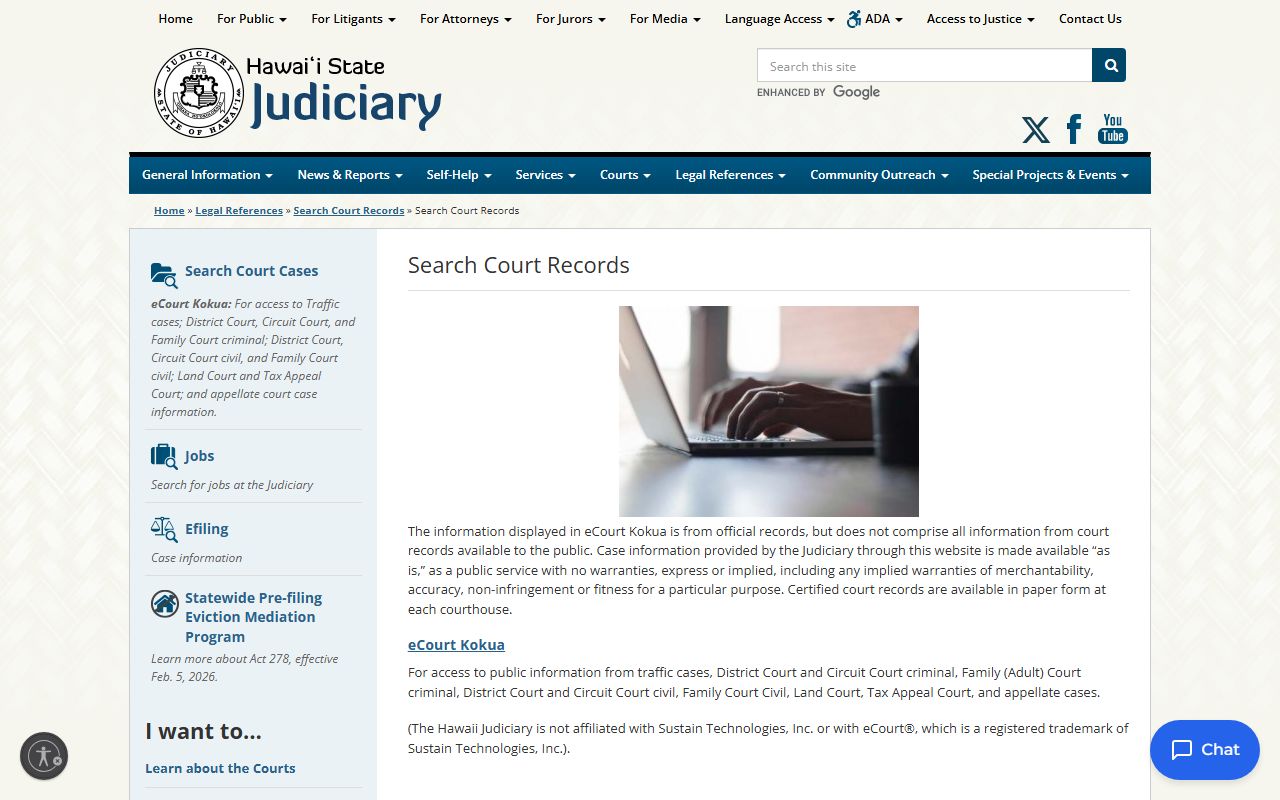
The Hawaii State Judiciary's court records search page is the official public access point for divorce case information statewide, available 24 hours a day at no charge for basic searches.
In-person searches are available at all courthouse locations during business hours. Free public access computer terminals let you view records without paying. You pay only when you want copies. If a case is more than five years old, the file may be stored off-site. Call the courthouse before visiting to confirm the file is available on-site.
What Hawaii Divorce Records Contain
A Hawaii divorce record is a court file, not a single sheet. When someone files for divorce, the clerk opens a case and assigns it a number. Everything filed in that case goes into the file. By the time a divorce is final, the file typically holds the initial complaint for divorce, financial affidavits, property settlement agreements, custody arrangements, child support orders, and the signed divorce decree. The decree is the court order that legally ends the marriage. It sets out all the terms that apply going forward, including property division, custody, and any support payments.
Under Hawaii's no-fault divorce law, the only ground the court uses is that the marriage is "irretrievably broken." No party has to prove fault. Hawaii Revised Statutes Chapter 580 governs the full process from filing to final decree. Courts may also grant a divorce when the parties have lived separately for at least two years, or after a separate maintenance order has been active without reconciliation for at least two years.
Most of the file is public. Financial documents like tax returns may be redacted. Records involving children can have limited access in specific cases. Confidential and sealed documents are not accessible through eCourt Kokua. Full sealed divorces are uncommon. Basic case data, the decree, and most filed documents are available to any person who requests them at the clerk's office or searches online.
Filing for Divorce in Hawaii
The Hawaii State Judiciary's divorce self-help page has forms, instructions, and guidance for people filing in any of the state's four circuits, including uncontested divorce packets for cases with and without children.
Hawaii is a no-fault divorce state. Under HRS §580-41, the court grants a divorce when the marriage is irretrievably broken, when the parties have lived apart for two or more years, or when a separate maintenance order has been active for at least two years without reconciliation. Marital misconduct plays no role in property division or spousal support.
Residency requirements are minimal. Act 69 of 2021 eliminated Hawaii's old six-month residency rule. Under HRS §580-1, you only need to be domiciled in the state at the time you file. There is no waiting period before that. Military members stationed in Hawaii qualify right away. For annulment or legal separation, three months of domicile or physical presence is required instead.
Filing fees at the Family Court are $215 for a divorce without minor children and $265 for a divorce with minor children. The higher fee includes a mandatory $50 parent education surcharge. When children are involved, both parents must complete a court-approved parent education program before the final decree is issued. Kids First Hawaii is the primary provider approved by the courts. Parents must file their completion certificate before the judge will sign the decree.
Under HRS §580-10.5, an Automatic Temporary Restraining Order takes effect the moment a divorce complaint is filed. It prevents either party from selling or hiding marital property, changing insurance or retirement beneficiaries, or moving a child off their current island or out of their school. The order stays in force until the final decree. Violating it can result in contempt of court and court sanctions.
Hawaii Family Court Forms and Locations
Each circuit publishes its own divorce packet. The First Circuit forms page has uncontested and contested divorce packets, with and without children. Forms include the Complaint for Divorce, the Automatic Restraining Order, financial disclosure statements, the Matrimonial Action Information form, and the Divorce Decree. The First Circuit was still revising its 100-plus forms as of 2022, so check revision dates on each document when you download.
The Third Circuit forms page has its own set of divorce packets for cases filed in Hilo or Kona. The Second Circuit and Fifth Circuit also publish circuit-specific packets. All forms are free through the state judiciary website.
Hawaii Family Court locations:
- First Circuit (O'ahu): Kapolei Judiciary Complex, 4675 Kapolei Parkway, Kapolei, HI 96707 | (808) 954-8000
- Second Circuit (Maui): Hoapili Hale, 2145 Main Street, Wailuku, HI 96793 | (808) 244-2700
- Third Circuit - Hilo: Hale Kaulike, 777 Kilauea Avenue, Hilo, HI 96720 | (808) 961-7400
- Third Circuit - Kona: Keahuolu Courthouse, 74-5451 Kamakaeha Avenue, Kailua-Kona, HI 96740 | (808) 322-8700
- Fifth Circuit (Kaua'i): Pu'uhonua Kaulike Building, 3970 Ka'ana Street, Lihue, HI 96766 | (808) 482-2330
All locations are open Monday through Friday, generally from 7:45 a.m. to 4 p.m., except on state holidays. Attorneys must file electronically through JEFS. People filing without an attorney can still submit documents at the courthouse window. The public access terminals page lists courthouse locations and terminal hours for on-site document review at no charge.
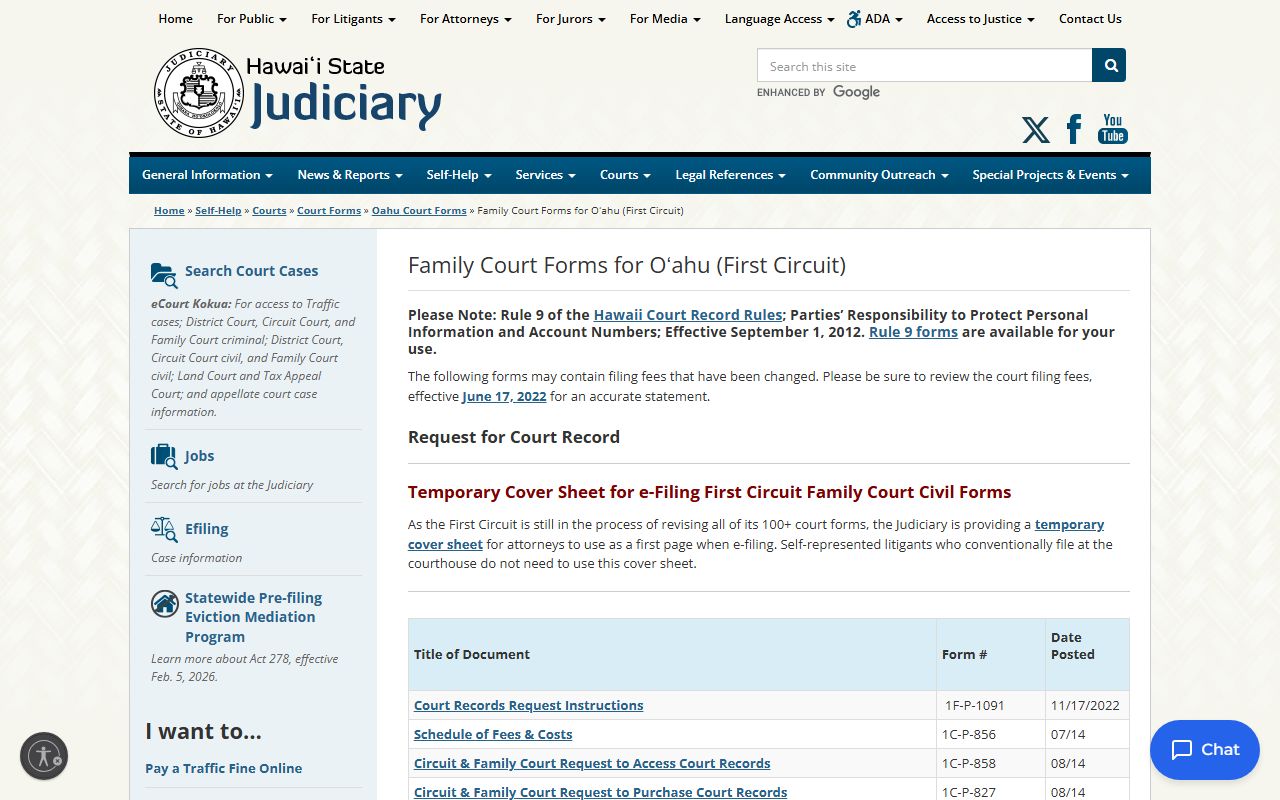
The First Circuit family court forms page provides all divorce packets for O'ahu cases, including forms revised as part of the court's 2022 form update project.
Hawaii Divorce Records by Judicial Circuit
Hawaii's circuit structure means that the court responsible for your divorce record depends entirely on where you lived when you filed. Filing in the wrong circuit is an error the court will flag. The First Circuit on O'ahu handles the most cases. The Second Circuit in Wailuku serves all of Maui County, including the smaller islands of Lana'i and Moloka'i. The Third Circuit operates dual divisions in Hilo and Kona to serve the Big Island's spread-out population. The Fifth Circuit handles all of Kaua'i from Lihue.
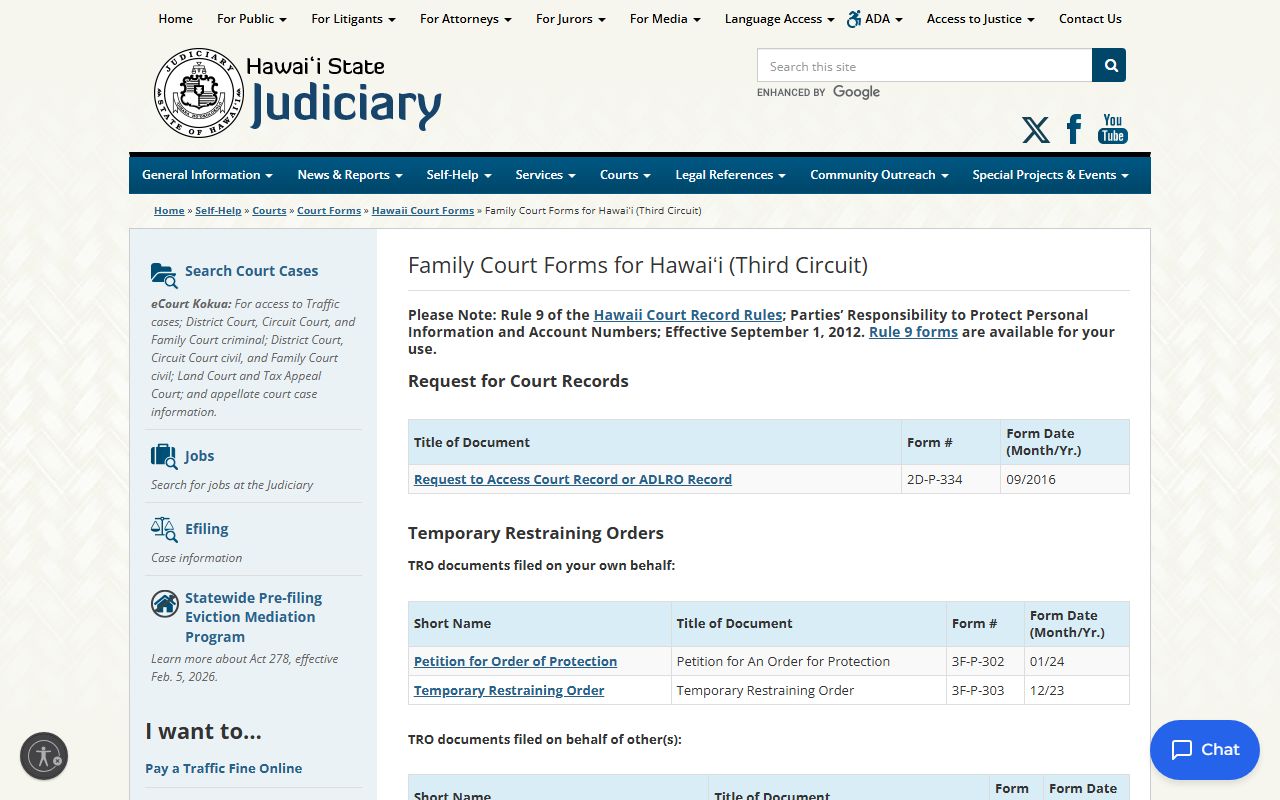
The Third Circuit publishes divorce packet forms for the Big Island, separate from the O'ahu or Maui forms, covering both the Hilo and Kona divisions of Hawaii County.
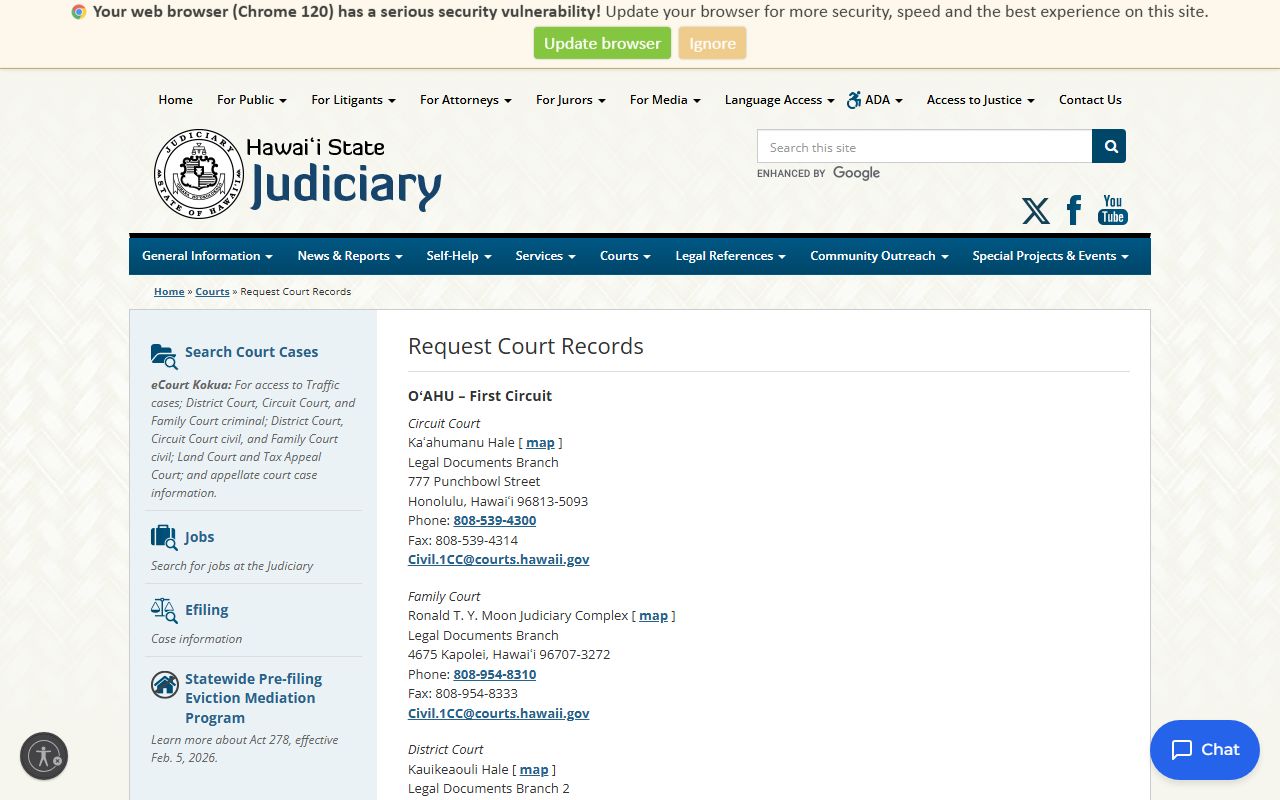
The First Circuit's court records request page details how to obtain paper copies of divorce case files from Ka'ahumanu Hale in Honolulu, including what information to include and accepted payment methods.
Historical Hawaii Divorce Records
The Hawaii State Archives holds divorce case files going back to 1848. These cover all four historical circuits. The First Circuit's O'ahu collection includes cases 1 through 2,415, covering 1848 to 1892. The Second Circuit has 319 cases from Maui dating to 1848 through 1915. The Third Circuit holds 424 Big Island cases from 1854 to 1899. The Fifth Circuit's Kaua'i collection has 206 cases from 1852 to 1899. All of these have been microfilmed.
Each old case file typically has an application for divorce, a summons, an affidavit of publication, the divorce decree, and statements from both spouses. They commonly note the date of marriage, where the parties lived, the grounds for the divorce, any children involved, and fees paid to the court. Some documents are in Hawaiian. The Archives staff has translated a portion of them into English. To request materials, you fill out a Records Request Form using the call number from the finding aid.
The Hawaii Digital Archives provides online access to some Third Circuit divorce case files. The Archives research room is at the Kekauluohi Building, 364 S. King Street, Honolulu, phone (808) 586-0329.
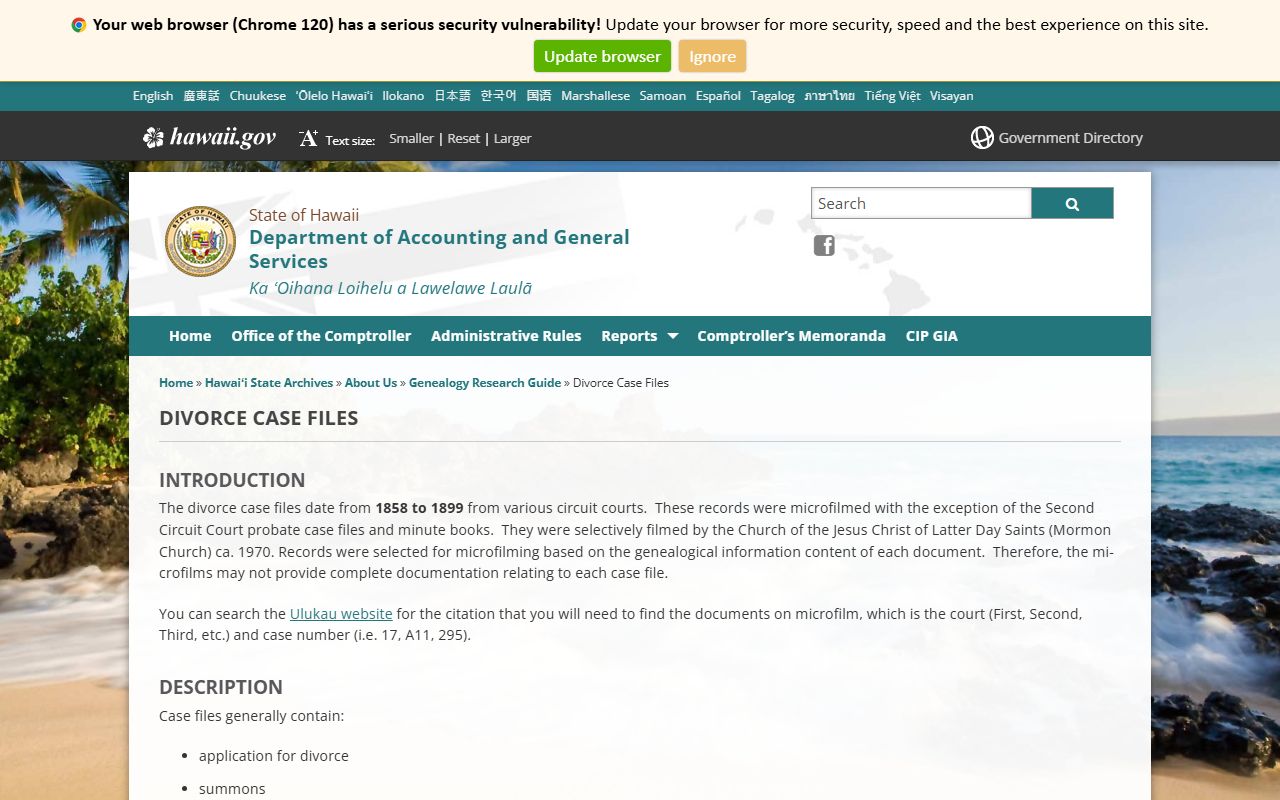
The Hawaii State Archives genealogy guide explains how to locate and request historical divorce case files by circuit, including microfilm reference numbers for each collection.
Parent Education Requirements in Hawaii Divorce Cases
When minor children are involved in a Hawaii divorce, both parents must complete a certified parent education program before the judge signs the final decree. This applies across all circuits. The $50 surcharge in the $265 filing fee covers this requirement. Both parents must submit a certificate of completion as part of the case file.
Kids First Hawaii is the primary court-approved provider of this program. Their curriculum focuses on how divorce affects children at different ages, how to manage co-parenting conflict, and how to support children through the process. Sessions are available on O'ahu and other islands. The program is aimed at protecting children's wellbeing rather than resolving disputes between the adults.

Kids First Hawaii provides the state-approved parent education curriculum required in all Hawaii divorce cases involving minor children, with sessions available on multiple islands.
Legal Help for Divorce in Hawaii
The Legal Aid Society of Hawaii provides free legal services to qualifying low-income residents statewide. They handle family law cases including divorce, custody, and support. Services are available on all major islands. Eligibility depends on income and assets. Their website has contact info for each island office and instructions for applying for assistance.
The Hawaii State Judiciary operates Self-Help Centers at most courthouses. Staff can help you find the right forms and explain the process. They can't give legal advice, but they can point you to what you need. The Kaua'i Self-Help Center runs on Thursdays from 9 a.m. to noon. Other locations have their own schedules.
The University of Hawaii Law Library court records guide lists search tools, legal aid organizations, and self-help resources for people navigating the Hawaii court system. It covers both current and historical records across all circuits.
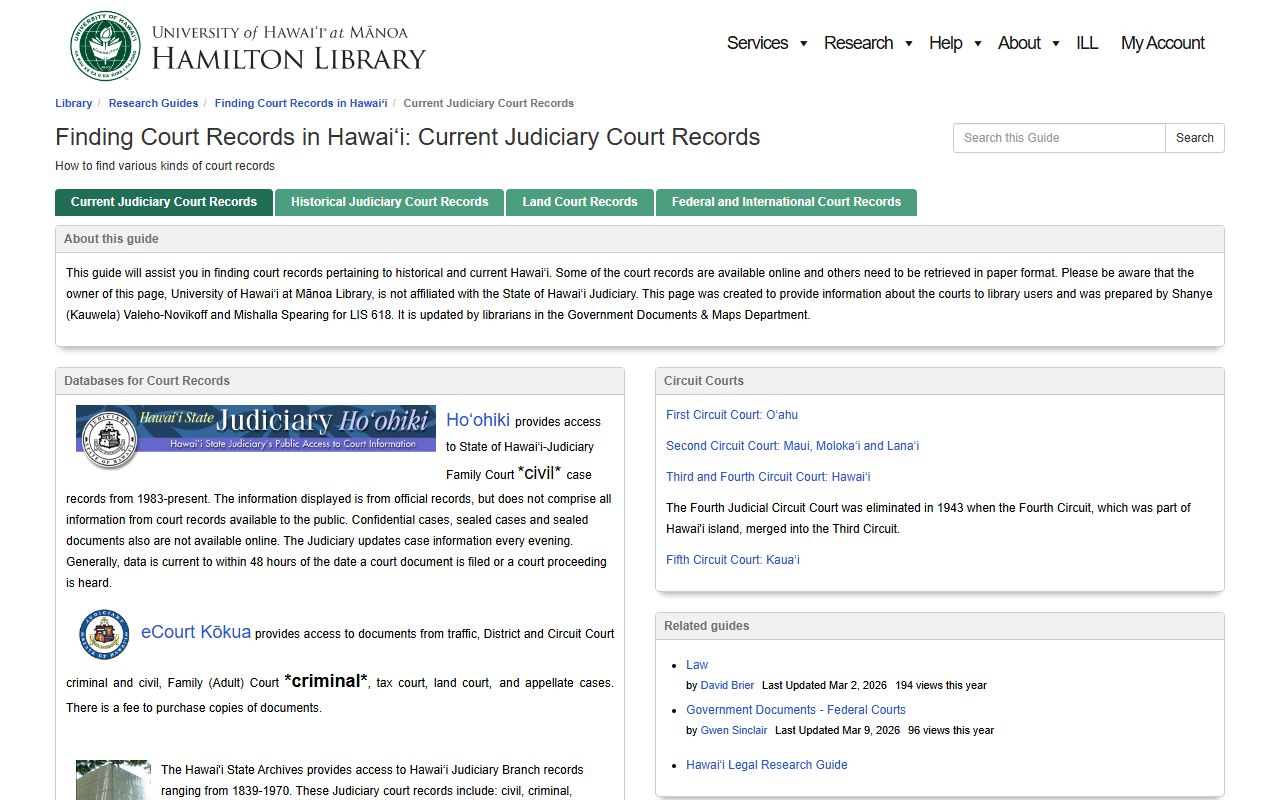
The University of Hawaii Law Library's online research guide covers how to access both current and historical divorce records in Hawaii, with links to search tools and legal resources for each circuit.
Hawaii Divorce Law Overview
All divorce law in Hawaii falls under HRS Chapter 580, covering jurisdiction, grounds, property division, spousal support, and the automatic restraining order. These rules apply statewide. Hawaii courts follow an "economic partnership" model when dividing marital assets, meaning the court looks for a fair split based on what each person contributed rather than applying a fixed formula.
HRS §580-47 governs property division. Hawaii is an equitable distribution state. The court can divide any property, whether jointly or separately owned, in whatever way it finds just and equitable. Courts weigh 13 statutory factors: the length of the marriage, each spouse's financial and non-financial contributions, earning capacity, the needs of any children, tax consequences of proposed divisions, and the standard of living during the marriage. There is no automatic 50/50 split, and the court has broad discretion to reach a fair result on the specific facts of each case.
HRS §580-10.5 creates the Automatic Temporary Restraining Order that takes effect when a complaint is filed. Neither party may sell, transfer, or conceal property, change insurance or retirement beneficiaries, or move a child off their home island. It stays active until the final decree. Violating it is a contempt of court matter.
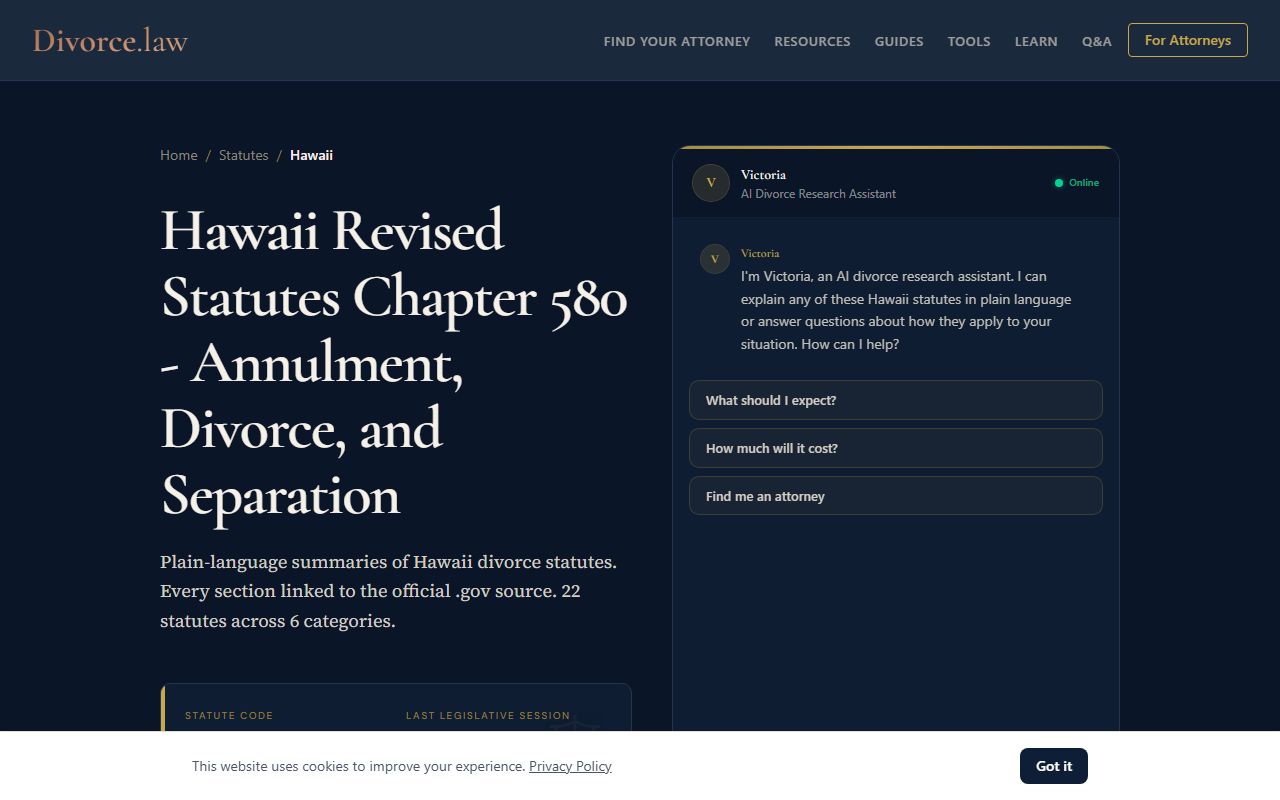
This legal reference resource covers Hawaii Revised Statutes Chapter 580 in plain language, including the key provisions on divorce grounds, property division, and spousal support that apply in all Hawaii family courts.
Are Hawaii Divorce Records Public
Yes. Court records in Hawaii are generally public. You don't have to be one of the parties to request copies. The eCourt Kokua system provides free access to basic case data for anyone. Certified copies and document downloads carry fees, but the records themselves are open. No reason is required when making a request at the clerk's office.
Some documents within a divorce file have restricted access. Sealed records, confidential cases, and documents with sensitive financial data like tax returns are not available through eCourt Kokua. Records involving children may have limited access in certain situations. A party can ask the court to seal specific documents, but this requires showing good cause and is not common. The vast majority of Hawaii divorce records are fully accessible at the courthouse or online.
Note: As of February 1, 2026, the Hawaii Department of Health no longer issues divorce certificates. All requests for certified divorce records now go directly to the Family Court in the circuit where the divorce was filed.
Browse Hawaii Divorce Records by County
Hawaii has five counties, each served by a specific judicial circuit. Select a county below to find Family Court contact information, local filing procedures, and resources for divorce records in that area.
Divorce Records in Major Hawaii Cities
Residents of Hawaii's cities file for divorce at the Family Court in their county's judicial circuit, not at a city office. Select a city below to find which court handles divorce records for that area, along with contact information and local resources.